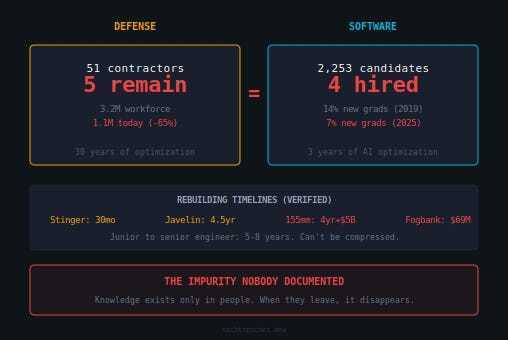
The defense industry lost the ability to make weapons when crisis hit. The same pattern is eroding software engineering skills. The timelines are identical.
Previously, to benefit from the full power of LLMs, you had to skew to higher parameter models. Recent developments in models like Gemma 4 and Qwen-3.6-35B-A3B demonstrate advanced capabilities such as tool-calling which enable LLMs to search the web, interact with external APIs and file systems, troubleshoot live systems and fundamentally reason about topics that lie outside of their initial training data.
The gap will take decades to close, if it ever does.
But regardless, the main point of the gap is resources
What makes you think we won’t have the resources in the future?
Any model that can run on 16GB or less, is not going to be any close in real world tasks, to any other cloud based model. It just cannot be.
Well you can compare Gemma 4 running in LM Studio on an average gaming PC to ChatGPT3.5 and you tell me? Or is your benchmark purely based on right at this very moment between open source models today vs cloud today?
For reference Gemma 4 is 26 billion parameters, gp3 thought to be over 175 billion and of course had no optimisations like MoE, it was searching its entire library every single question so was rather slow as well
We know as well that there is no slow down in pushing for optimisations, Deepseeks initial release was the initial driver for you don’t have to just scale up using hardware alone
They’re also pushing with Chinese native chips from Huawei trying to diversify away from nvidia holding the crown
The problem I’ve got is that you all have a god of the gaps, the conversation I was having 3 years ago was different to 2 years ago was different to 1 year ago, I was told AI could never do songs good enough then suddenly people were worried they couldn’t tell the difference, then they said they could never do movies, now apparently not only is it good enough it’s hilarious
The open source LLM’s we have today are incredible and in the last few months we’ve had Qwen, GLM, Nemotron/Nvidia, Mistral, Google and heeaaps of others released, it feels like you’re just looking for a reason to be dour and pessimistic but that’s just me


deleted by creator
2026’s average gaming PC is massive amounts of memory and compute apparently
lol there are plenty of open source models in the top 100 with multiple SOTA models released in the last few months alone
There’s also smaller LLM’s being made like https://eurollm.io/ which excel in their own ways
Funny that just came up: https://discourse.ubuntu.com/t/the-future-of-ai-in-ubuntu/81130?=0
😁
deleted by creator
What makes you think we won’t have the resources in the future?
Well you can compare Gemma 4 running in LM Studio on an average gaming PC to ChatGPT3.5 and you tell me? Or is your benchmark purely based on right at this very moment between open source models today vs cloud today?
For reference Gemma 4 is 26 billion parameters, gp3 thought to be over 175 billion and of course had no optimisations like MoE, it was searching its entire library every single question so was rather slow as well
We know as well that there is no slow down in pushing for optimisations, Deepseeks initial release was the initial driver for you don’t have to just scale up using hardware alone
https://research.google/blog/turboquant-redefining-ai-efficiency-with-extreme-compression/
They’re also pushing with Chinese native chips from Huawei trying to diversify away from nvidia holding the crown
The problem I’ve got is that you all have a god of the gaps, the conversation I was having 3 years ago was different to 2 years ago was different to 1 year ago, I was told AI could never do songs good enough then suddenly people were worried they couldn’t tell the difference, then they said they could never do movies, now apparently not only is it good enough it’s hilarious
https://www.youtube.com/watch?v=fgHn7PI55J4
The open source LLM’s we have today are incredible and in the last few months we’ve had Qwen, GLM, Nemotron/Nvidia, Mistral, Google and heeaaps of others released, it feels like you’re just looking for a reason to be dour and pessimistic but that’s just me
Any way I’m off to sleep, have a good one :)
deleted by creator