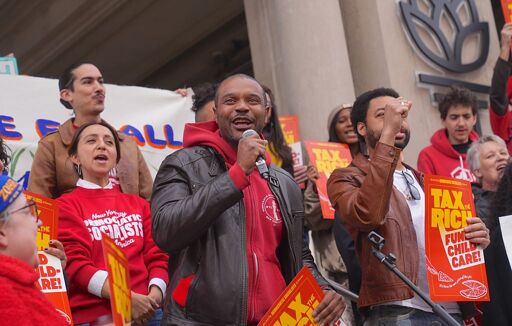
Could democratic socialism become the brand of a new generation of political actors — not just on the fringe, not just in New York City, but across the country?
instead of the inflammatory weasel-wording ‘what if socialism takes over’ like it’s some kind of coup.
If I can give some context, as a DSA member, while DSA is parasitizing the Democratic ballot line, it essentially acts like an independent party.
The goal isn’t necessarily to “take over” the Democratic Party. Rather, the dominant position in DSA is what’s called a “Dirty Break”, where the org parasitizes the Dems in the short term, essentially until they kick us out (Ideally in such a way that DSA comes out the stronger org, and that the Dems whither not unlike the Whigs).
Something which is already starting to happen, with Democrats telling us to go “make our own party” as though we haven’t looked at the US political system, and ruled that out for now.
Further, DSA is a big tent organization, with everyone from reformist social democrats, to Anarchists, Trotskyists, Marxist-Leninists, etc. And the DSA party platform (the updated version of which gets released on the 14th, I believe) expresses an overt desire by DSA to transcend capitalism. So this isn’t just a return to FDR style social Democracy, like you’re suggesting, there’s a bit more going on
Good luck getting that motley crew to get along. Everyone can agree on anticapitalism but that’s basically it. How exactly to go about it is going to vary widely. It’s hard to see Marxist-Leninists wanting to play ball with reform advocates.
It’s still a good idea worth trying. I’m just skeptical of lefties ever turning into a cohesive force since there’s such a wide array of leftism and some of the particulars of given ideologies are mutually exclusive.
I mean, this isn’t a project that started yesterday, and it isn’t some hypothetical. DSA has existed in its current form, a big tent with ideological and strategically based caucuses, for a little over a decade at this point. If anything the caucus system, which currently codifies those different tendencies in the org, makes it stronger. People within DSA debate endlessly about everything under the sun, but the minute any one part of the org is attacked by someone on the right, the org rallies around them, generating greater organizational coherence. It’s like having siblings. You can bully your little brother, but god forbid anyone else tries it.
Additionally, caucuses allow DSA members to collaborate across chapters in ways that national is improving on, but not currently able to fully facilitate. Caucuses also exchange ideas, strategies, etc. in ways that general membership might not do otherwise.
And that, I think, is what has allowed DSA to grow in the way that it has. All of these left tendencies are forced to come to the table in order to get what they want, instead of just imploding into a billion little sects. And those negotiations, both among caucuses, and with material conditions, mean that DSA is able to formulate a cohesive program and strategy.
I think the Caucus system, as it currently stands, will probably have to be done away with at some point, if DSA is to cohere more power, and thus a greater sense of party discipline, but for now, I think it’s a strength of the org, not a weakness.
Yeah, the left is unfortunately mired with purity tests and No True Scotsman fallacies. Meanwhile, the right is laser focused on marching directly towards fascism. It’s like watching a game of tug-of-war, except one side has people tripping their teammates, or loudly complaining about how they got rope burn one time so they’re going to refuse to participate.


If I can give some context, as a DSA member, while DSA is parasitizing the Democratic ballot line, it essentially acts like an independent party.
The goal isn’t necessarily to “take over” the Democratic Party. Rather, the dominant position in DSA is what’s called a “Dirty Break”, where the org parasitizes the Dems in the short term, essentially until they kick us out (Ideally in such a way that DSA comes out the stronger org, and that the Dems whither not unlike the Whigs).
Something which is already starting to happen, with Democrats telling us to go “make our own party” as though we haven’t looked at the US political system, and ruled that out for now.
Further, DSA is a big tent organization, with everyone from reformist social democrats, to Anarchists, Trotskyists, Marxist-Leninists, etc. And the DSA party platform (the updated version of which gets released on the 14th, I believe) expresses an overt desire by DSA to transcend capitalism. So this isn’t just a return to FDR style social Democracy, like you’re suggesting, there’s a bit more going on
Thanks for the clarification, I feel like very little of this was discussed in the article and you explain it better.
Good luck getting that motley crew to get along. Everyone can agree on anticapitalism but that’s basically it. How exactly to go about it is going to vary widely. It’s hard to see Marxist-Leninists wanting to play ball with reform advocates.
It’s still a good idea worth trying. I’m just skeptical of lefties ever turning into a cohesive force since there’s such a wide array of leftism and some of the particulars of given ideologies are mutually exclusive.
I mean, this isn’t a project that started yesterday, and it isn’t some hypothetical. DSA has existed in its current form, a big tent with ideological and strategically based caucuses, for a little over a decade at this point. If anything the caucus system, which currently codifies those different tendencies in the org, makes it stronger. People within DSA debate endlessly about everything under the sun, but the minute any one part of the org is attacked by someone on the right, the org rallies around them, generating greater organizational coherence. It’s like having siblings. You can bully your little brother, but god forbid anyone else tries it.
Additionally, caucuses allow DSA members to collaborate across chapters in ways that national is improving on, but not currently able to fully facilitate. Caucuses also exchange ideas, strategies, etc. in ways that general membership might not do otherwise.
And that, I think, is what has allowed DSA to grow in the way that it has. All of these left tendencies are forced to come to the table in order to get what they want, instead of just imploding into a billion little sects. And those negotiations, both among caucuses, and with material conditions, mean that DSA is able to formulate a cohesive program and strategy.
I think the Caucus system, as it currently stands, will probably have to be done away with at some point, if DSA is to cohere more power, and thus a greater sense of party discipline, but for now, I think it’s a strength of the org, not a weakness.
Yeah, the left is unfortunately mired with purity tests and No True Scotsman fallacies. Meanwhile, the right is laser focused on marching directly towards fascism. It’s like watching a game of tug-of-war, except one side has people tripping their teammates, or loudly complaining about how they got rope burn one time so they’re going to refuse to participate.