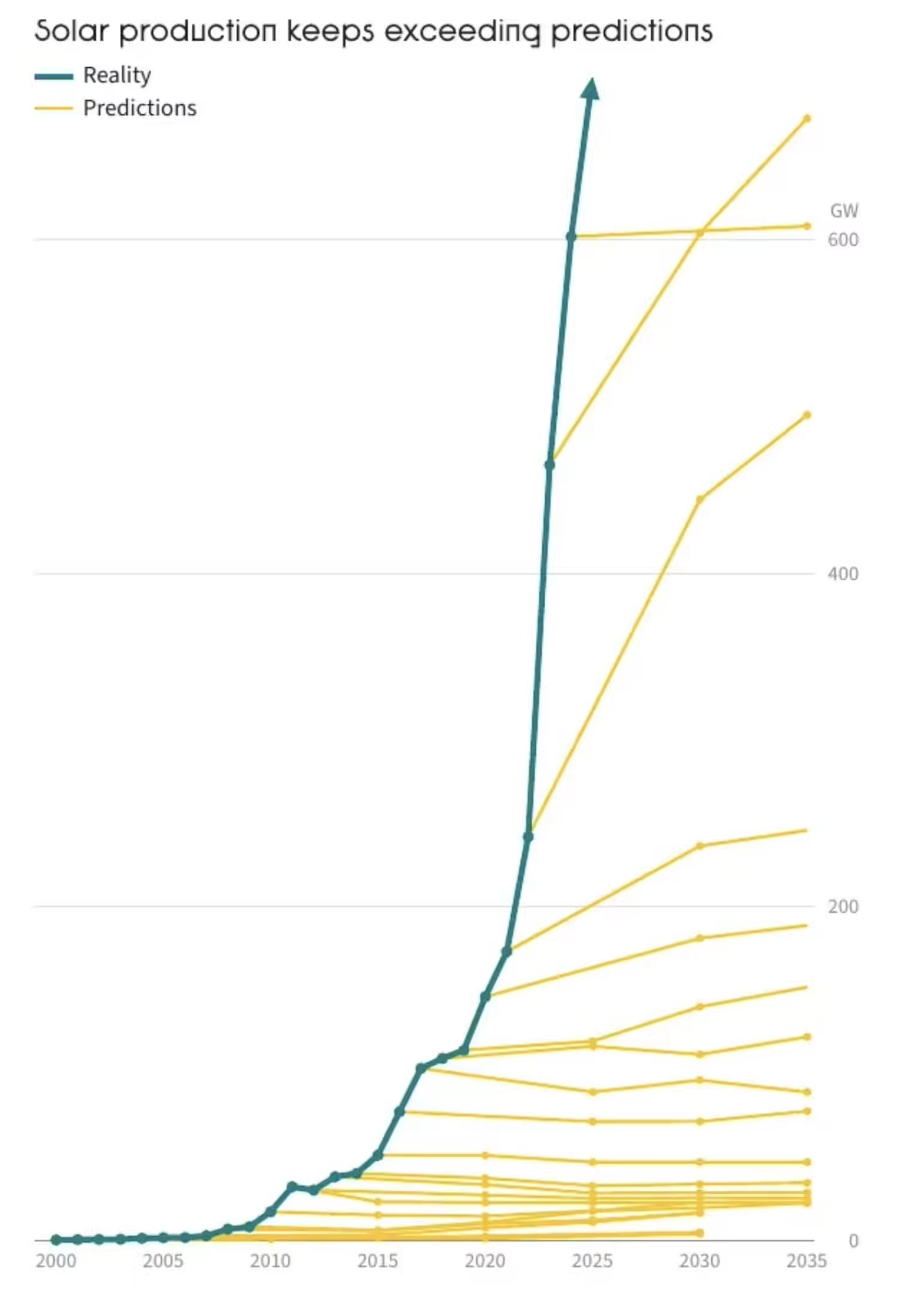
Because it was being artificialy suppressed.
Now we need to figure out how to suck emissions out of the air with it.
Build 75m tall towers in every city and fill them basement to roof with hepa filters.
Bring new meaning to the term “skyscraper”
Its almost like solar panels last forever and are easy to make at scale or something.
The only thing left to do is make them affordable and efficient. ~$2 per watt is ridiculous. Solar panels need to either get better at absorbing light, or the price needs to come down.
I recall that some asian country (I can’t remember if it was Japan or China) used recycled glass to make solar road tiles that work like chain LEDs. These were porous enough to let water seep through, yet strong enough to handle several years of being a road surface. The practical upshots of this are myriad; The dark color aids in snow melt, the tiles are easy to replace, and cheap to produce, they can have other infrastructure wired to their reverse side, such as data fibre, or even battery packs to store excess charge and most importantly, when applied at scale they are both the the power generator and distribution network combined. There was even talk of making them piezoelectric, so that traffic driving over them would also generate useable current.
Perovskites is the answer rn, there are several perovskite products from Poland.
They already are affordable enough to be the cheapest source of energy in many places
Cheapest as in “over the lifecycle”, not initial investment.
Who tf made that last prediction?
Yeah I know it’s been growing exponentially over the last few years and the last prediction was higher than this and it blew through that one but I really think this is the absolute plateau. Maybe like 1MW more but that’s it …
All the displayed predictions are equally stupid and just look like gas and fuel lobby copium.
TBF we’re talking about the industry that tricked the entire globe into thinking leaded gasoline was safe. Falsified data. Hired scientists to lie in congress. All while fully knowing the dangers.
This is much more sinister than copium.
Xi did this.
Fuck Xi. Piece of shit genocidist. A handful of good deeds doesn’t make up for committing mass murder.
Extraordinary claims require extraordinary evidence.
Independence from the billionaire fascists that want to control my energy is worth paying a premium for. The fact that it’s also cheaper is a nice bonus though.
Great news for everyone who likes energy.
( 😆 )
Great news for every living being on earth.
Generally yes. Although technically, there could be some species that won’t be affected by changing climates as much as us humans and our fragile infrastructure.
My quip was mostly about the O&G industry constantly using “energy” to mean the “fossil fuels” subset.
Nothing will be completely unaffected, but it may not actively harm everything equally.
Forget about the predictions and look at the growth only. It’s the legendary hockey stick. The stuff MBAs dream about. US manufacturers, engineers and the less shitty VCs should be fucking furious that they were kneecapped at every step and basically forbidden from participating in this market in any real way.
How was anyone in America stopped? Trump is pulling federal money from renewable projects as fast as he can, but he can’t control private enterprise money. Even here in conservative NW Florida, solar farms are exploding across the landscape, all private enterprise.
They might look like they’re exploding in the US, but not at all compared to what could have been happening in the same time period had Trump allowed even the milquetoast Biden-era policies to continue (to say nothing of expanding on them). China, who has invested heavily in solar and battery R&D and manufacturing, installed more solar power than the rest of the world combined in 2025 and holds over 80% of the global market share for solar panels. They are the world leaders in the nearline battery chemistries that already make solar+battery the cheapest form of power by a longshot, and have half of the world’s installed capacity of battery storage systems. We could have had a seat at that table, but we’re now a decade behind in tech R&D and manufacturing capability. The private sector knows this, which is why they won’t touch it without strong federal support.
the only one what looks like a legitimate prediction is the one what crosses 400GW. starting 2023? 2024?
Yeah what the fuck is that 600GW prediction. Did they think collectively the solar industry would be like, “okay y’all we reached 600GW, pack it up goals reached”?
Reading into it a bit more, they updated their algorithm in 2021:
In 2021, the IEA adopted for the first time a new hybrid modelling approach relying on the strengths of both models. The integrated framework of the IEA’s Global Energy and Climate Model (GEC Model) is now the principal tool used to generate detailed sector-by-sector and region-by-region long-term scenarios across IEA publications, including the World Energy Outlook series and Energy Technology Perspectives series.
https://www.iea.org/reports/world-energy-outlook-2025#methodology
who’s making the predictions, the petrol industry?
The predictions aren’t even doing linear regression, feels like taking 10 year old data and fitting on current trend
a toddler with a sharpie you say?
Especially 2012-2020 seems ridiculous. “Its been an exponential growth until now but it will probably instantly stop here and stay constant”.
Solar generated 2,807 TWh of electricity worldwide in 2025, 8.8% of the total.
(Source)
Its taken us decades to get to this point and solar can easily do 5x that much generation without even thinking the word battery, and close to 10x with just daily battery backup.
Surely it’ll plateau any second now…
Lol what is that latest preduction? “Sure, solar production has risen like never before, but surely now the production will plateau.”
listen, I have been wrong every time, but this time, when I make the same prediction that has been wrong every time previously, you’re gonna feel real dumb for doubting me
Depends who the study is funded by - if it’s fossil fuels, then yes.
With all these data centres driving demand, probably not any time soon.
Aren’t they mostly running on fossil fuels?
Yeah, because they also run at night…
Solar while day gas during the night is a very common scheme. Works well with solar and wind because gas turbines can spin up very quickly.
LLM datacencers just don’t care about the environment, nor costs past a year or so and prioritize speed over everything. They can’t be bothered getting more land and permits for renewables.
They’d be in the perfect position to cut their gas use in half with 2 years roi, or to two thirds or less with maybe 5 years roi. I suppose even they don’t think it can continue on like this.Effectively Techbros, bankers and billionaires don’t care about carbon pollution killing us all. It can’t be the case or they may have to change the way they do business.
War, sanctions and oil crisis all make solar more attractive
But that would also make countries energy independent. So can’t have that.
For the life of me I can never figure out how countries don’t see renewables, and solar in particular, as a national security issue.
Distributed electricity? Yes please.
I mostly agree, but all those cloud connected inverters talking to Chinese servers are giving me the heebie-jeebies.
It’s corruption. Anyone with the power to make that decision is compromised in some way.
Money and control, solar gives too much freedom to the end user.
Were that the issue, home solar would be illegal wheras instead it was federally subsidized for years. The truth is simple, oil money buying politicians.
They do, everyone does. The psychopaths in the oil industry lobby govrrnments for slow uptake, and literally kill people to stay where they are.
To the
moonsun!!Dyson swarm / sphere will be the ultimate goal
If only we could be so grossly incandescent!
\ [T] /
i wonder how this will affect the grid. it will for sure flatten out the curve during the day, maybe even leading to excess capacity we’d have to burn off. what magnitude of storage would we need to actually use all the extra power?
Massively increased long-distance transmission lines between different climates are a must. A lot of investments are being made there but it turns out building thousands of miles of high voltage lines is a pretty slow process now that it isn’t the 50s and 60s.
It is economical to store the surplus, so it will happen.
My utility provider gives lower rates during 1000 to 1500. People are setting their washing machines (timers), air conditioner (house as a thermal battery), oven (not all stuff, but some) etc on a timer. I’m sure some companies could adjust their processes to take advantage of excess solar: run more equipment and harder in preferential times, etc.
There are products like UPS+battery which are trying to add battery storage to well matched products and these might go a long way to provide a 1-5% storage for most houses and companies in future, just enough to tide over the duck curve in mornings and evenings.
Hopefully the rest can be managed by the utility providers
that only works for people who own their homes, unfortunately.
Hmmm, this has been part of the debate since solar power started up. Batteries both grid and home size are being installed all over. The cost is falling rapidly and the grid forming batteries are providing all the services of a power station.
there are still pretty big problems with them though, like materials and cost. i’d love it if every home could top up the grid but the forming inverters are bulky and costly for individuals. hopefully used traction batteries can start making up the difference in cost but personally i’d rather see more large-scale solutions like pumped hydro.
also, anecdotally, as someone in a country where we were already basically fossil-free, with a 50-50 split between hydro and nuclear, installing more renewables has coincided with the grid becoming less stable. the rapid fluctuations in available power has seemingly driven up energy costs. i theorise it’s because larger variations in grid frequency is more taxing on the hardware.
Force home solar to have grounding maybe
the rapid fluctuations in available power has seemingly driven up energy costs. i theorise it’s because larger variations in grid frequency is more taxing on the hardware.
You need batteries for this which in turn make things cheaper and more reliable overall.
you need to get those batteries from somewhere.
Whats your point? Yes when you build something you need to get said something from somewhere.
that here, there are no plans for integrating battery technology into the grid, no plans for where to get them, and no system to regulate their use. what we do have is lots of old pumped hydro facilities that were shut down because they were “not profitable enough”.
I mean ya, if you don’t have plans to do it, then it doesn’t happen, but batteries are what help stabalize solar/wind input. If they have decided to go into solar/wind and you’re having grid instabilities because of it, they should build batteries.
The batteries also help with the Nuclear plants since they often don’t run at full capacity overnight which is wasted energy as they need to spin them down. If you have batteries you can also be storing that during the evening, which means you need less solar during the day.
Pumped hydro and grid-scale battery storage seem to be the two main methods.
Pumped hydro accounts for 95% of grid scale storage. It’s the only thing viable for significant energy storage with batteries taking on more of a capacitor role.
The reason pumped hydro is 95%
(if that’s true)is because until very recently batteries weren’t a viable option and available in the scale required.That’s no longer the case. There’s limits to where you can do pumped hydro, but pretty much anywhere you can drop a solar array down, you can drop a substantial amount of batteries.
Batteries are going to dwarf pumped hydro in the not so distant future.
Edit: To put this into perspective, the USA has ~553 GWh of pumped storage. Tesla alone in the USA has 1 40GWh factory running, and a 50GWh factory about to come online, so they’ll have a yearly 90GWh install capacity, 130GWh if you include the China factory. Then there’s BYD, CATL, Panasonic and LG all doing battery storage, and things like Sodium batteries are about to come online at scale that are even cheaper.
https://www.energy.gov/cmei/water/hydropower-market-reports (553 source)
That’s because of capitalism. Pumped hydro has huge startup costs and a long payoff period, but runs basically forever. That’s not good next quarter stock market returns.
Batteries are exactly the disposable need to be completely thrown out and re bought every 5-10 years that the private sector loves to sell the government.
Pumped hydro beats batteries $/KwH before the first time you have to throw them all out every time.
You talk about China, and they’re doing exactly what I said. They’re building pumped hydro capacities over 10x their battery storage capacity.
Again I’m not against batteries they’re a great complimentary technology for surge demand and local backup. But nothing beats the simplicity and efficiency of moving water from a mountain Lake to a valley lake.
Commercial scale grid batteries last 15-20 years and can be deployed in months not years, and the permitting is dramatically less. The grid batteries will be up and earning profits before you even break ground on those pumped hydro locations.
But yes I’m sure once you build the pumped hydro it can be cheaper over decades. Also unless they’re a closed loop system, they’re susceptible to drought which could impact their usage in the future.
Yeah. That’s what I said. Grid scale batteries create lots of profit for big corps. But if you want cost effective long term massive capacity energy storage you go pumped hydro. You can guess who fucked up our regulations and stopped our governments from pursuing these kinds of nation building projects: the same corps selling us batteries and coal and gas power. All based on the idea of endless fuel and battery purchases from them. They also did the same to solar, hydro, wind, and nuclear energy because those don’t really have recurring costs they can profit on forever.
Drought is generally not a concern for pumped hydro because you control the flow and you can pump both ways. In some cases it’s part of a normal hydro generation plant at a dam and then maybe some places might have minor drought susceptibility, but that affects net energy generation rather than storage capacity.
I don’t think one really has to burn off solar capacity? Just raise the inverter input to match the voltage and no current will flow. Would be kind pointless to waste the capacity though, I think Sweden or somewhere had success with melting salt with excess power.
are you thinking of the finnish sand battery?
Ah that’s the one, yep
The incoming sunlight will still get converted into electrical energy, it’s just going to get burned of right there inside the panel instead of somewhere else on the grid.
Are these selected bad predictions? I find it hard to believe some of them, but when they are cherry picked it would make sense.
https://en.wikipedia.org/wiki/International_Energy_Agency#Bias_against_renewable_energy seems they’re just biased against solar
Yeah, these guys are paid clowns 🤡