

https://konto.zssk.sk/zk/new#step1
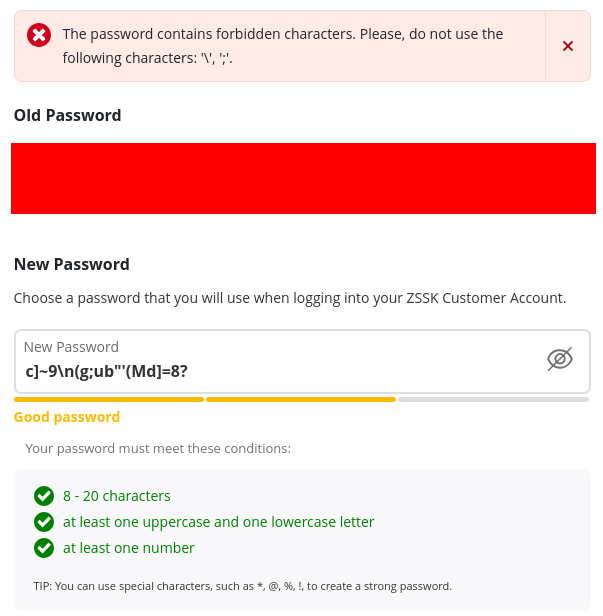
Also, it only seems to show “Strong password” if any of these characters is used: !@, and not other special characters.
How feasible is it to attack argon2id with that method?
argon2id is one of those newer algorithms created specifically to make cracking infeasible and protect against certain side channel attacks.
An example performance from an Nvidia 90HX for LUKS is:
So correctly implemented, basically impossible lol.
Hashcat also added recent support for argon2id standalone and keepassxc db, so I’ll see if I can run my own benchmark just to see what it shows.
Thanks! I was curious because I am using keepass and I do use argon2id lol. I was a bit skeptical because the 2s benchmark parameter seems oddly small, but nice knowing that it is actually quite good.
On a GTX 1660:
-------------------------------------------------------------------------------
* Hash-Mode 34300 (KeePass Argon2 (KDBX v4)) [m=65536, t=2, p=2] [Kernel: pure]
-------------------------------------------------------------------------------

Speed.#01........:      434 H/s (75.99ms) @ Accel:67 Loops:4 Thr:32 Vec:1

-------------------------------------------------------------------------------------------------------------
* Hash-Mode 70000 (Argon2id [Bridged: reference implementation + tunings]) [m=65536, t=3, p=1] [Kernel: pure]
-------------------------------------------------------------------------------------------------------------

Speed.#*.........:       39 H/s

--------------------------------------------------------------------
* Hash-Mode 36100 (yescrypt) [N=4096, r=32, p=1, t=0] [Kernel: pure]
--------------------------------------------------------------------

Speed.#01........:      431 H/s (164.40ms) @ Accel:264 Loops:2048 Thr:32 Vec:1
For some context, my keepassxc on my PC registers about t=50 for a 1 second unlock delay, so the example benchmark t=2 is faster than an IRL example, hence why the reference argon2id is much lower with only an additional transform round (t=3).
But yeah it’s definitely good, and since argon2id allows you to set the parameters (memory, transform rounds, parallell) you can go make it hilariously indestructible if you feel like waiting like 30 seconds to unlock a DB lol.