

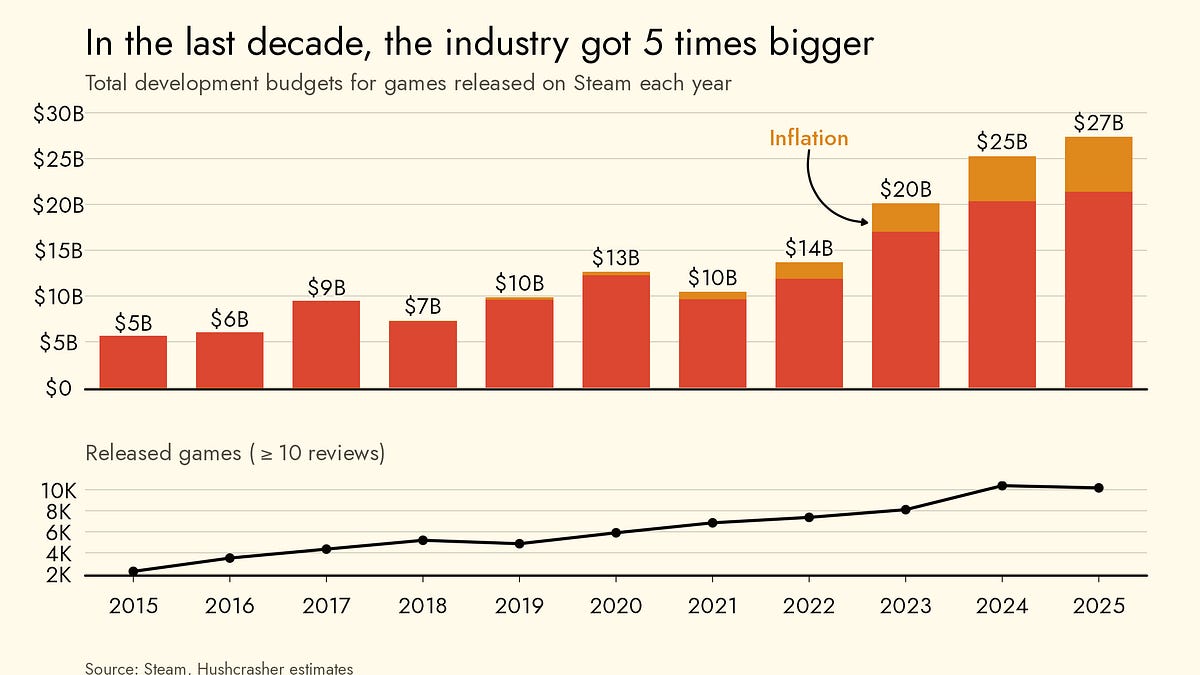
Yes, they did, but there are measurements to go along with that.
They really did get more costly.
As the industry moved to having C-suite executives and parasite-class CEO trash who have absolutely no creativity or useful leadership capabilities involved in the business, the drain on funds and resources sky-rocketed without an iota of improvement to the games… just laundering more money from the worker-developers into the hands of executive shitstains and investor scum.
Not so much covered in this article, but the vast majority of the spending is in paying more developers, and executive pay, which is largely in stock, isn’t a large contributing factor. Your favorite game from 25 years ago was probably made by 30 people in 18 months, and now the equivalent level of production value today is made by somewhere between 300 and 1500 people over a longer stretch of time.
My favourite games of today are also made by fewer than 30 people though
Yeah, that’ll happen. You can’t make Elden Ring or Baldur’s Gate 3 with that team size though.
Not played those. You can make Factorio with that team size
And how long it took that sized team to make Factorio?
Oh right, 8.5 years, from the first concept prototype, to the official version 1.0 full release, according to the dev themselves: https://www.factorio.com/blog/post/fff-360
I think you actually just illustrated exactly OP’s point with your exceptionally poor example here, Factorio is absolutely an outlier in every way, including how it literally started a whole new genre, which absolutely does NOT happen with the majority of video games ever developed.
Ok, but if great games exist why should I care about the ones that are only good?
If you haven’t played Elden Ring or Baldur’s Gate 3, I’d say that you haven’t played two of the greatest games of all time. And I love me some Factorio.
deleted by creator
The old adage is that nine women can’t make a baby in a month, but that doesn’t mean that there isn’t a time and place for large team sizes. Large games employ large teams because that’s the only way they get made. I’m definitely first in line to say that lots of large games could stand to be smaller instead, but there are plenty that I like just the way they are, and they’ll need large teams. That means they’ll be expensive to make.
Some bits absolutely can benefit from thowing bodies at them though. Animation is one of the key areas for that: if you want to give thousands of models hundreds of unique animations you absolutely can split that up by having 100 animators do 10 each rather than 10 doing 100 each.
The increase in desire for graphical fidelity and custom naturalistic animation is a huge driver of the balloning teams and budgets for the AA and AAA games.
deleted by creator
Clair Obscur and BG3 spring immediately to mind as games with incredibly high production values (=large teams working for a long time) that were successful both commercially and critically. So yes some people do care about that. Especially if you are wanting to make a large mass-market game you cant rely on being the next person to make a terraria or stardew valley.
deleted by creator
You’re being needlessly agressive in calling people who have a different opinion to you dipshits.
Clair Obscur in particular would not have worked without the graphical beauty it had. Without wanting to give too much away the game itself is heavily wrapped up in visual art as a medium for both the narrative and the gameplay and it would not havev worked (imo) if the graphics looked poor in comparison to it’s peers at the time.

There’s certainly been some industry-wide brain drain, especially when it comes to low-level engineering. When you think about the memory-level mastery people exhibited to get things running on the PlayStation 1, it feels incomparable to today.
Those people enjoyed being pioneers and recognized that was the only way to achieve their dream; but they’re also valued so highly today (picture publishers willing to buy out entire other publishers to get hold of a game engine), chances are they will never have a simple job.
Worse, some MBAs don’t even recognize their value; and wrongly believe they can be easily replaced. There’s probably some ecological comparative example where a great oak is central to the ecosystem of a whole country, and a business developer claims “We can bulldoze that for farmland and import fertilizer, right?”
deleted by creator
some MBAs don’t even recognize
Ahhh
Sorry
Going to read it, but some early questions come to mind, like if they considered the average per-game cost, if they considered standard deviation, if they considered the average income of a developer or from a developer’s country, etc.
Answering myself: seems pretty complete indeed.
Though a further question comes to mind, thanks to @Shellofbiomatter@lemmus.org’s meme, how do these expenses translate to profits? And further into the tangent, it could be analysed if it’s a trend, or a bubble reading to burst.
It’s broken down by scope of the project, into four main buckets, seemingly not by country.
An uneducated thought on the subject. Game development doesn’t cost much more today than years ago. Game companies are just spending more on game development. It’s a choice, not a requirement